One morning my 9 year old wasn’t feeling very well. Over this covid-period I have experienced that every cough or sneeze makes me wonder if there is a virus in our house. So after I had a good look at my daughter, I decided there was no school for her that day. As a lot of parents might recognise, once you gave the sign green to stay at home most of the symptoms disappear like snow for the sun. This morning I thought: ‘’no school for her today, but she is not really ill, so that gives me time to study with her on something I like’’.
My favourite topics are art or history, so I chose Art, typical Dutch art, Rembrandt van Rijn, 17th century, Amsterdam. The Dutch had become famous for there trade around the world. Business was going well, every well known tradesman wanted a portrait of him or his family. The local painter Rembrandt van Rijn was one of their favourite. He still is, for many art-lovers, the best 17th century Dutch painter.
The best place to see a good collection of the work of Rembrandt is of course the Rijksmuseum in Amsterdam. I remember back in 1992, my first job as a building engineer at the building site of the Rijksmuseum. The project was to realise a basement under a part of the museum. The site manager learnt me a lot about the building itself. The story I have always remembered is the one of the museum hall for the ‘Nachtwacht’ by Rembrandt van Rijn. It was designed for this painting. J.P.Cuypers the architect of the Rijksmuseum, knew how special this artist was and how valuable this painting was for the city and the country. On one of the tours trough the building I went to the roof, to the space above the ‘Nachtwacht’ and there I saw this special roof and floor construction of glass. It was created to get the best possible light into the museum hall below, to influence the volume of daylight. All because this painting should shine in the best possible way. Over the years museum directors argued if this room had enough light for the Rembrandt painting or if it was the right light to preserve the painting. With the last big restauration of the museum, which took 10 years and was finished in 2013, the historical roof construction for the daylight was placed back in its full glory and filled with led lights.
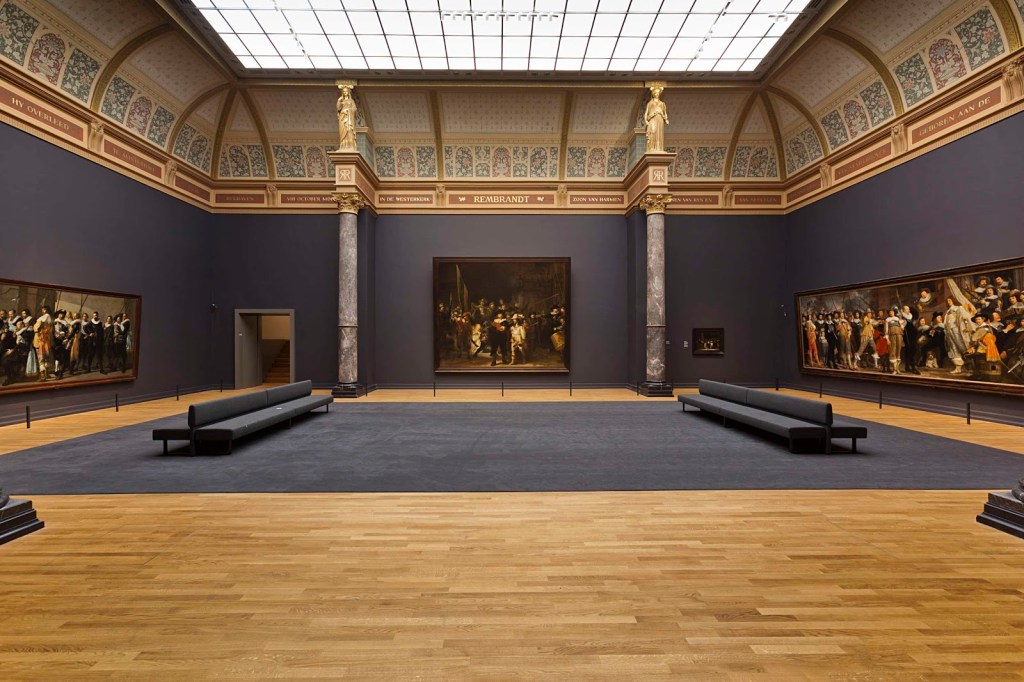
This focus on the light is not strange if you know that light in a painting was Rembrandts specialty. He loved to play with it. In every portrait you see light from different angles. In the 17th century, light was not artificial but mostly a natural thing. So that makes me wonder if Rembrandt was inspired by the morning or evening sun? Or maybe it was the light of candles?
Another marker that made Rembrandt famous is the movement, dynamic in his paintings. Look at ” experience the Night Watch” ad you will find out why this movement is so special. If in 1642 a group of people would be painted in a portrait, they would be clearly visible, nicely stand or sit next to each other. If you compare that to this painting the composition must have been seen as chaos in those days. Why did van Rijn put the little unknown girl in full light? She was not that important, the guards were they eventually had paid for the portrait.
As you might have see in ”experience the Night Watch’ that Rembrandt painted in great detail. He was known for it. In his portraits you see a lot of wrinkles. This was also a way to work with light, wrinkles causes shadows. Rembrandt really painted in such a fine realistic detail. The persons in the paintings didn’t always look beautiful, they looked realistic. There are a many self-portraits of Rembrandt van Rijn. It is told that he used those to learn to paint mood expressions. There are sketches from a young Rembrandt and paintings of a dressed up old Rembrandt, all made with great detail.

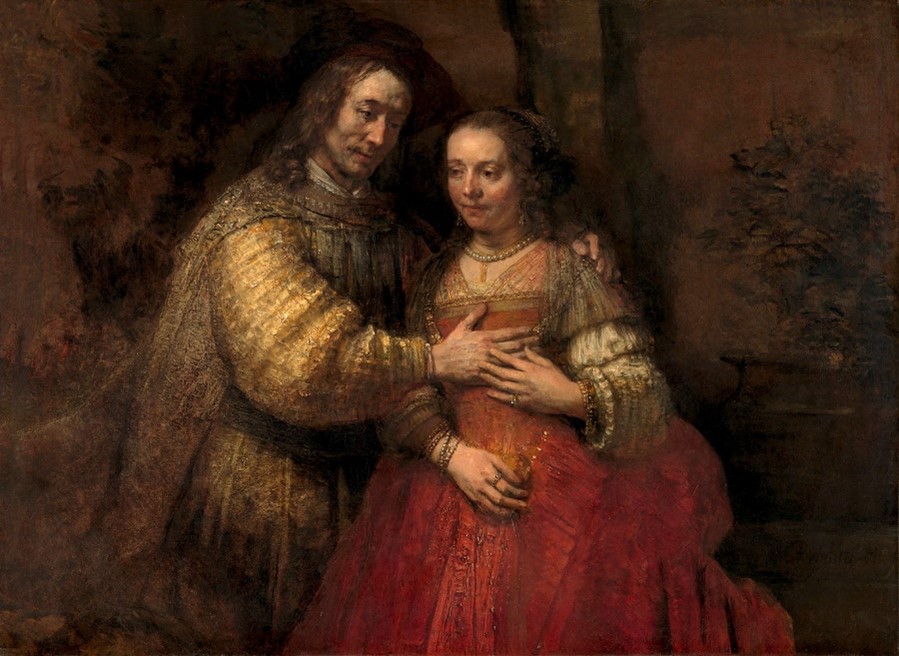
Not only the faces are painted in great detail, looking at the clothes you can almost feel the fabric, so carefully detailed it is painted. The older Rembrandt becomes the cruder he paints . ‘The Jewish bride’ as one of the later paintings in which you see blobs of paint and brutal putty strokes which are composed in such a way that you can feel the heaviness of the fabric of the mans jacket. In the same painting you see the fine lines of the pearls in the necklace of the woman. Every time I have the opportunity to see this painting, I can just stand there and look at it and dream away, the story of the persons who are painted and who created this beautiful piece of art.
Back to the morning with my sick daughter. I found this Dutch children’s program ‘KLOKHUIS’ in which they cover different topics of Dutch history. My daughter and I watched the episode ‘Rembrandt’. It felt to me like a fairy tale in which we became friends with the people of the 17 century in Amsterdam. The film was good and just right for the age of my daughter. I love it when adults understand that it is not necessary to tell the story in every detail as long as they tell it in a understandable and interesting way for kids.
But as always the best comes last.
After watching the film and talking about Rembrandt and the age he lived in my daughter asked me ,Can we go and see the’ Nachtwacht’ next time we are in the Netherlands?’
Mission accomplished…….
 I spy with my historical eye