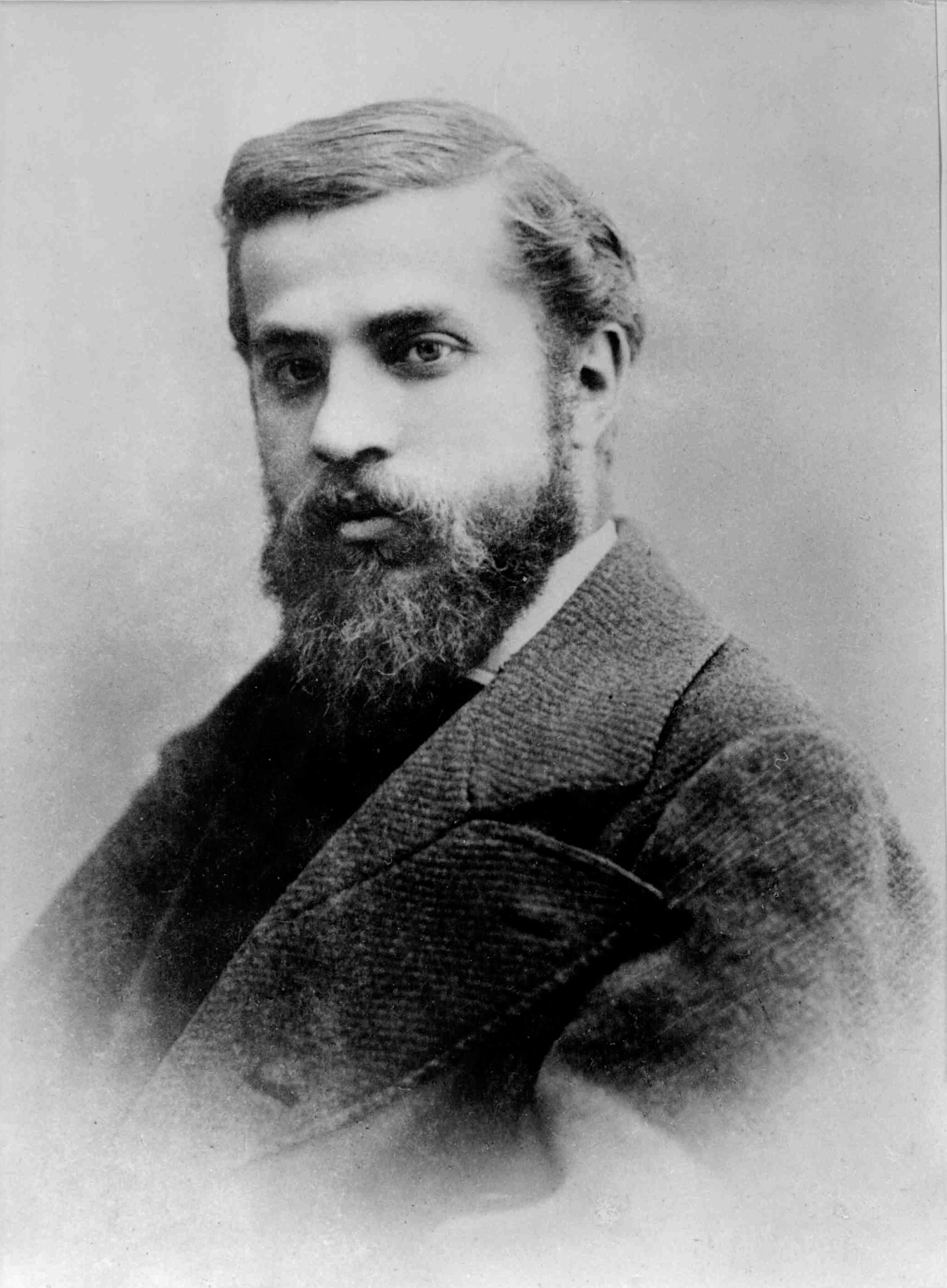
I spy with my historical eye… imagine a city in southern Europe at the beginning of the 20 th century. The industry is growing, the population is expanding, and new neighbourhoods are emerging beyond the old medieval walls. In the middle of all this change, one building site stands out. A church unlike any other. Its towers do not follow the strict lines of traditional architecture. Instead, they rise like sculpted forms, full of curves and textures. Stone seems to flow and shift. It looks less like a building imposed on the landscape and more like something that has grown from it. At the centre of this extraordinary project is an architect with an unusual idea: that the best design comes from studying nature. His name is Antoni Gaudí. And here, in the heart of Barcelona, he is creating something that will change the way we see architecture forever.
A Childhood of Observation
Antoni Gaudí was born in 1852 in Catalonia, not far from Barcelona. As a child, he spent a great deal of time outdoors. Because he often suffered from poor health, he could not always take part in physical games with other children. Instead, he observed the natural world around him. Plants, shells, insects, and stones all became objects of curiosity. Gaudí watched carefully how things were built in nature. He noticed how branches divide to support the weight of a tree, how bones carry loads within the human body, and how patterns repeat in leaves and flowers.
Architecture Inspired by Nature
The childhood observations became the foundation of Gaudí`s architectural vision, guiding the way he thought about structures and space. He began designing buildings in Barcelona, and his work immediately stood apart from that of his contemporaries. Instead of straight lines and flat surfaces, his buildings used curves and organic forms. Columns could branch like trees. Surfaces were covered with colorful mosaics made from broken tiles and ceramics. Light and space were used in ways that created a sense of movement and life.
His ideas shaped remarkable landmarks across Barcelona:
- Park Güell, a park where winding paths, terraces, and mosaic benches blend architecture with the surrounding hillside.
- Casa Batlló, whose facade resembles bones and shells, with a roof often compared to the back of a dragon.
- Casa Milà, a residential building with flowing stone walls and a roofshape filled with sculptural chimneys.
Together these works helped define the distinctive architectural character of Barcelona.

The Architect and His Project
The clearest example of this philosophy can be seen in the basilica Sagrada Família, the project that became Gaudí’s life’s work.
In the final years of his life, Antoni Gaudí devoted himself completely to the construction of the Sagrada Família. For him the church was far more than a building made of stone and mortar. It was what he called a “hymn to God.” Every detail was designed with a meaning: the facades, sculptures, an columns were meant to tell a story of faith and reflect the beauty of the divine. Gaudí’s designs blended Gothic traditions with sweeping, organic shapes inspired by nature, creating a style that was both innovative and deeply spiritual.
Inside the basilica, the columns rise and branch out like the trunks and canopy of a forest, giving visitors the feeling of standing among trees rather than inside a conventional church. divide like the trunks and branches of a forest. Sunlight filters through the stained-glass windows, filling the space with shifting colours that change throughout the day. Gaudí lived very simply during this time and worked closely with craftsmen to bring his vision to life.
Then, in June 1926, tragedy struck.
While crossing a street in Barcelona, Gaudí was hit by a tram. Because he was dressed modestly and carried no identification, people initially believed he was an unknown elderly man. Only later was it discovered that the injured person was the architect whose work had transformed the city’s skyline. Antoni Gaudí died on June 10, 1926. At the time of his death, the Sagrada Família was still in its early stages of construction.
A Project That Outlived Its Creator
Despite Gaudí’s death, work on the basilica continued. Architects, engineers, and craftsmen studied his drawings, models, and notes in order to carry forward his vision. Over the decades, progress was slow. Wars, economic difficulties, and technical challenges delayed construction many times. Yet the project never stopped completely. Today, the Sagrada Família is recognised as one of the most remarkable architectural achievements in the world, and several of Gaudí’s works are protected as World Heritage Sites by UNESCO.
The year 2026 marks the 100th anniversary of Gaudí’s death, and it also marks a major milestone for the basilica.On February 20, 2026, the upper arm of the cross was installed on the Tower of Jesus Christ, completing the external structure of the central tower—the highest point of the Sagrada Família. This moment marked the completion of the tower’s exterior, bringing Gaudí’s vision for the skyline of Barcelona closer to reality. Interior work on the structure will continue through 2027 and 2028, but the full height of the basilica can now be seen rising above the city.
A century after his death, Antoni Gaudí still captivates architects, designers, and travellers from every corner of the globe. Huis buildings prove that architecture can be bold, inventive and inseparably tied to the natural world. In my opinion, the orgins of that genius trace back to something beautifully simple: a curious cild, quietly watching the world around him and letting nature spark his imagination.
 I spy with my historical eye