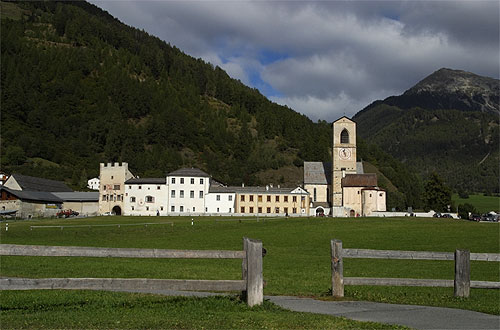
There are places where time seems to stand still, where every stone carries the whispers of centuries. Müstair is one such treasure. Tucked away in the upper Rhine valley of Switzerland, just a short journey from the Italian border, this cloister has a history stretching back more than 1,250 years.
The Benedictine Abbey of Müstair, likely founded under Charlemagne around 775, stands at a unique crossroads in the Alps. Charlemagne was one of Europe’s most powerful medieval rulers, King of the Franks and later crowned Emperor of the Romans in 800. He promoted Christianity and encouraged the founding of monasteries throughout his vast empire—places like Müstair that became centers of faith, learning, and art. For centuries, this abbey offered shelter to pilgrims and travelers navigating between northern Europe and Italy. since 1983 it is recognized as a UNESCO World Heritage Site, and with good reason.
Inside the abbey, the air is cool and faintly scented with old wood and beeswax. Light filters gently through small, arched windows, illuminating the oldest and most complete cycle of figurative murals in Switzerland, painted around the year 800. The Carolingian frescoes and later Romanesque images of Christ’s life and the Last Judgment seem to glow softly against the ancient plaster. Their colors are muted by time, yet their message still resonates. The thick stone walls echo quietly with the sound of footsteps, and if you linger long enough, you might hear the distant chanting of the sisters—a sound as old as the abbey itself.
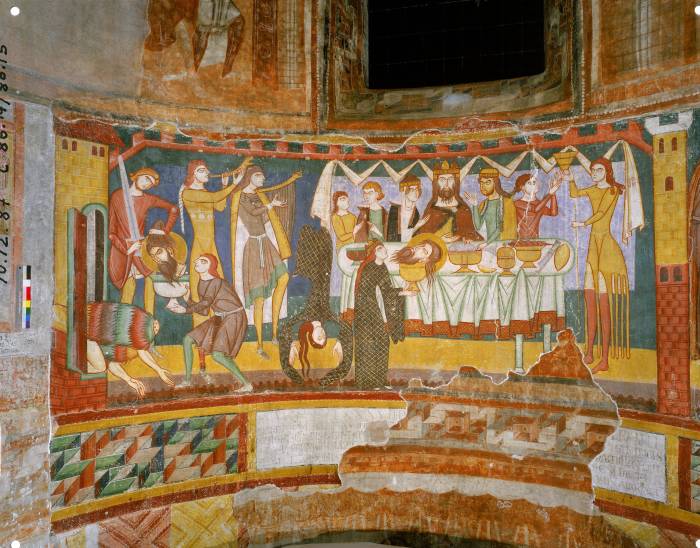
You’ll find these remarkable murals in the Abbey Church of St. John, particularly adorning the nave and apses, forming a narrative decoration of faith and artistry that spans centuries. You can even explore them from afar with a virtual tour of the convent.
The monastery is not just a historic relic; it remains a living community, where Benedictine sisters still follow the Rule of St. Benedict. That continuity is what fascinates me most. Cloister life feels like stepping into another world within our own. Beyond those walls, life moves fast and loud, but here the rhythm is different. The daily cycle of prayer, work, and silence has remained steady for over a millennium. Walking through the quiet courtyards, feeling the cool Alpine breeze and hearing the gentle toll of the bells, I felt as though time had folded in on itself.
Outside, the snow-dusted peaks rise above emerald meadows, framing the abbey as if nature itself wished to protect this haven. The grandeur of the Alps magnifies the cloister’s simplicity, inviting you to slow down, to look closer, to breathe deeper.
If you ever wander between Switzerland and Italy, let yourself be drawn to Müstair. It’s more than a stop on a map; it’s a living window into history and a rare glimpse into another way of being—quiet, enduring, and deeply connected to both faith and the mountains. While you can view its murals in a virtual tour, nothing compares to standing among the cool stones, hearing the silence, and watching the light touch the ancient walls. The atmosphere here makes them powerful, more moving than any screen could ever convey.
 I spy with my historical eye