When I go on a city safari, some buildings give me an instant feeling of warmth and wonder—one of them is always a library. Stepping inside, I enter a world of stories, history, and imagination, where I can picture the authors behind the books and the countless visitors who have been there before me.
So when I visited St. Gallen a few weeks ago, I was thrilled to discover one of the world’s most extraordinary libraries, nestled in the heart of this Swiss city. The Abbey Library of St. Gallen is not just a place of books. The text above the entrance tells me I’m entering a healing place of the soul.
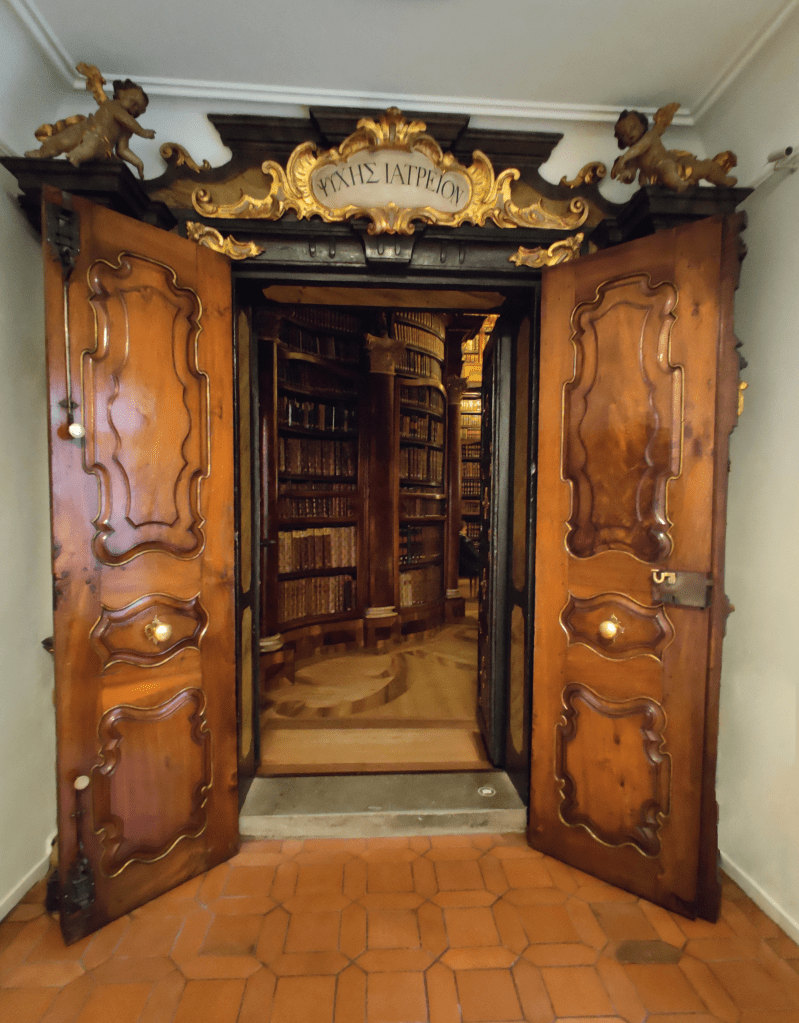
Walking through these doors, I was struck by the opulence of the Rococo-style interior—the woodwork, the painted ceilings, and the sense of timeless elegance. But what truly fascinated me was the library’s story—its ancient origins, the dedication of the monks who built it, and its survival through the many political changes that threatened its existence.
Back in the 7th century, an Irish monk named Gallus traveled across Europe, spreading Christianity and learning. According to legend, his journey came to an unexpected halt when he tripped over a thorn bush near a river in what is now Switzerland. Taking this as a divine sign, he decided to settle there, building a small hermitage in the wilderness. Over time, other monks joined him, and by 719 AD, this humble settlement had grown into the Benedictine Abbey of St. Gallen, one of the most significant monasteries in medieval Europe.
During the Middle Ages (500–1500 AD), monasteries were not just places of worship—they were centers of knowledge, education, and culture. The monks at St. Gallen were dedicated to the study of science, medicine, history, and languages, turning the abbey into an intellectual hub. But they didn’t just study; they also became guardians of knowledge. With no printing presses and paper still unknown in Europe, books had to be copied by hand onto parchment (animal skin). These manuscripts were lavishly decorated with golden embellishments and detailed illustrations, each one taking months or even years to complete.
At the time, Europe was in unrest. The fall of the Roman Empire had left cities in ruins, and war and invasions threatened to erase centuries of accumulated wisdom. Books and knowledge were at risk of being lost forever. Monasteries like St. Gallen, with their thick stone walls and secured archives, became safe havens for learning. Preserving knowledge was not just an intellectual pursuit—it was a sacred duty. The monks believed that saving books was a way of serving God, ensuring that wisdom could be passed on to future generations.
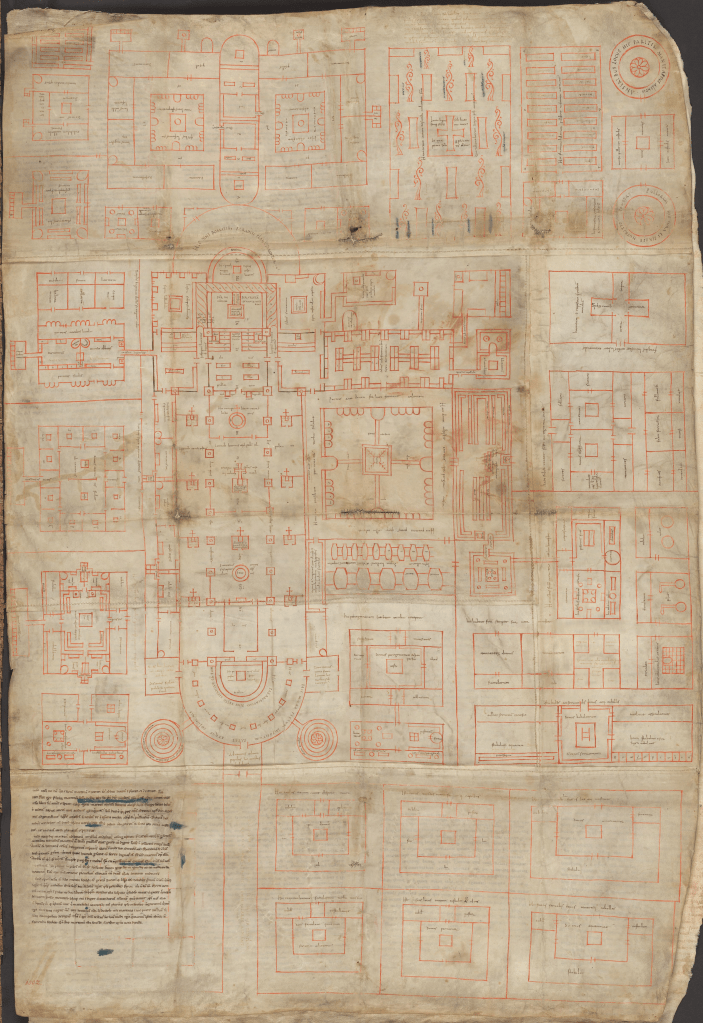
Today, visitors to the Abbey Library and Museum can still see some of the treasures that have been protected within these walls for centuries. One of the most fascinating is the St. Gallen Monastery Plan, a 9th-century architectural drawing that provides an incredible glimpse into how medieval monasteries functioned. It is the oldest known blueprint of a monastic complex, revealing a carefully designed, self-sustaining community where every building had a purpose. Even the animals the monks kept were not just for food but played a crucial role in producing parchment for bookmaking.
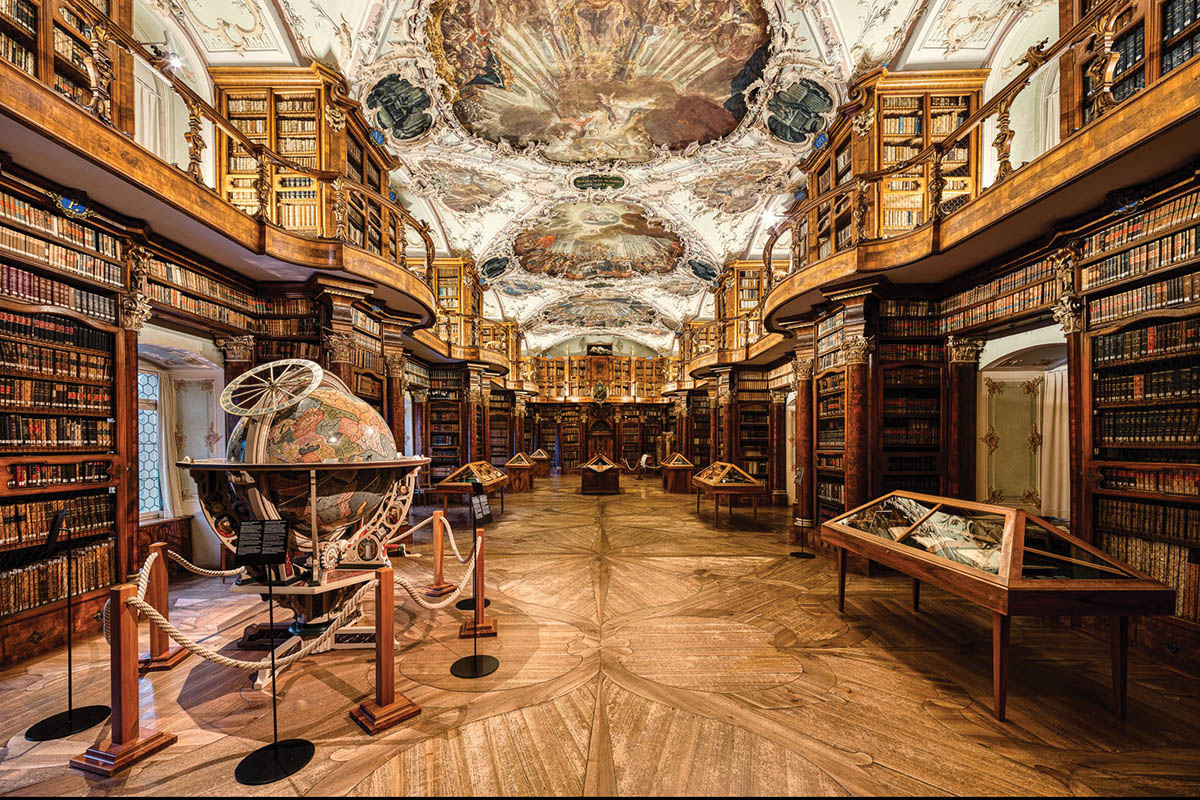
For centuries, the monks of St. Gallen dedicated themselves to preserving knowledge, carefully building one of Europe’s most remarkable library collections. By the mid-18th century, their vision extended beyond the manuscripts themselves—they sought to create a space worthy of housing their treasured works. The result was the Rococo-style library hall, designed by Austrian architect Peter Thumb, an expert in Baroque and Rococo architecture. Constructed between 1758 and 1767, this stunning hall remains one of the most breathtaking libraries in the world.
The grandeur of the Abbey Library was soon overshadowed by the political upheaval of the late 18th century. Napoleon Bonaparte’s influence was reshaping Europe, weakening the power of the Catholic Church and its monasteries. In the year 1798, Switzerland fell to French troops, leading to the establishment of the Helvetic Republic—a new government determined to strip monasteries of their wealth and land.
Like many others, the Monastery of St. Gallen became a target. It controlled vast resources, making it an easy mark for state confiscation. In 1805, the newly formed government of the Canton of St. Gallen officially dissolved the monastery. The monks were forced to leave, and the monastery’s buildings were repurposed for secular use.
Yet, despite the monastery’s closure, its library survived. Recognising the cultural and historical value of the collection, local scholars and leaders stepped in to protect it. Unlike in other parts of Europe, where monastic books were looted or destroyed, the Abbey Library of St. Gallen was spared. Instead of being scattered, its manuscripts and books remained intact, and the library was transformed into a public institution, allowing scholars and visitors alike to explore its treasures.
Today, the Rococo library hall still stands in its original form, a testament to centuries of learning and preservation. In 1983, it was officially recognised as a UNESCO World Heritage Site, securing its place as one of the world’s most important historic libraries. More than just a collection of books, the Abbey Library of St. Gallen represents the endurance of knowledge, the resilience of cultural heritage, and the power of a community to protect its past for future generations.
Visiting the Abbey Library of St. Gallen was for me like the text above the entrance; a healing space for the soul. A place to pause, breathe, and let history wrap itself around you. So, if you’re ever in St. Gallen, step inside and let your Historical Eye wander—because some places don’t just tell history, they let you feel it.
 I spy with my historical eye