La Grange Geneva in the spotlights of the world
A historical presidential summit is held on the 16th of June in Geneva. Joe Biden and Vladimir Putin are meeting each other face to face. Swiss media is all excited and it is seen as an opportunity for Swiss diplomacy. Reference is made to the historic summit in Geneva between Reagan and Gorbachev. It is being hailed as a diplomatic success for Switzerland. Back in 1985, the two world leaders met each other at Fleur d’Eau, a villa in Versoix. Now in 2021, Biden and Putin are to meet in the Grange Villa in the park Grange on the south side of lake Geneva.
After reading about this summit, I got curious about the park and the villa. I have been there once, briefly, while visiting Geneva. The park has been a public place since 1917. That is the year the last private owner, William Farve donated the estate to the city of Geneva. He studied chemistry at university of Geneva and Berlin, travelled to Turkey and Egypt. He was a traveller, historian, army officer, patron of arts, municipal councillor, a benefactor, a bachelor and had no heirs. The land had been in the family for several generations. His great-grandfather François Favre (1736-1814) had brought it from the Geneva based family Lullin. While donating his families estate to the city of Geneva, William Farve made some restrictions. The villa could only be used by the administration of the city of Geneva and to welcome distinguished guests to the city. The park on the other hand should be held in perpetuity for the enjoyment of the people of Geneva. That is why the people of Geneva can enjoy the park every day of the year and the villa is open, only once a year, with a ticket for a guided tour.
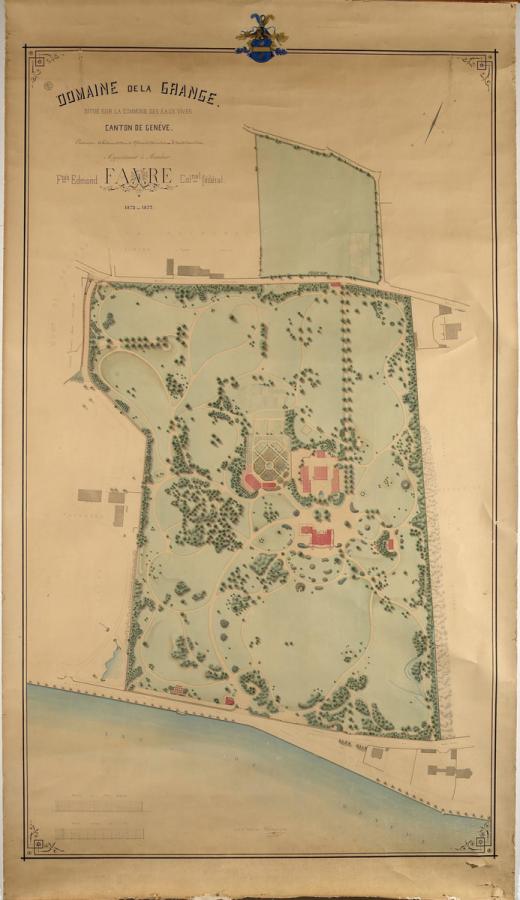
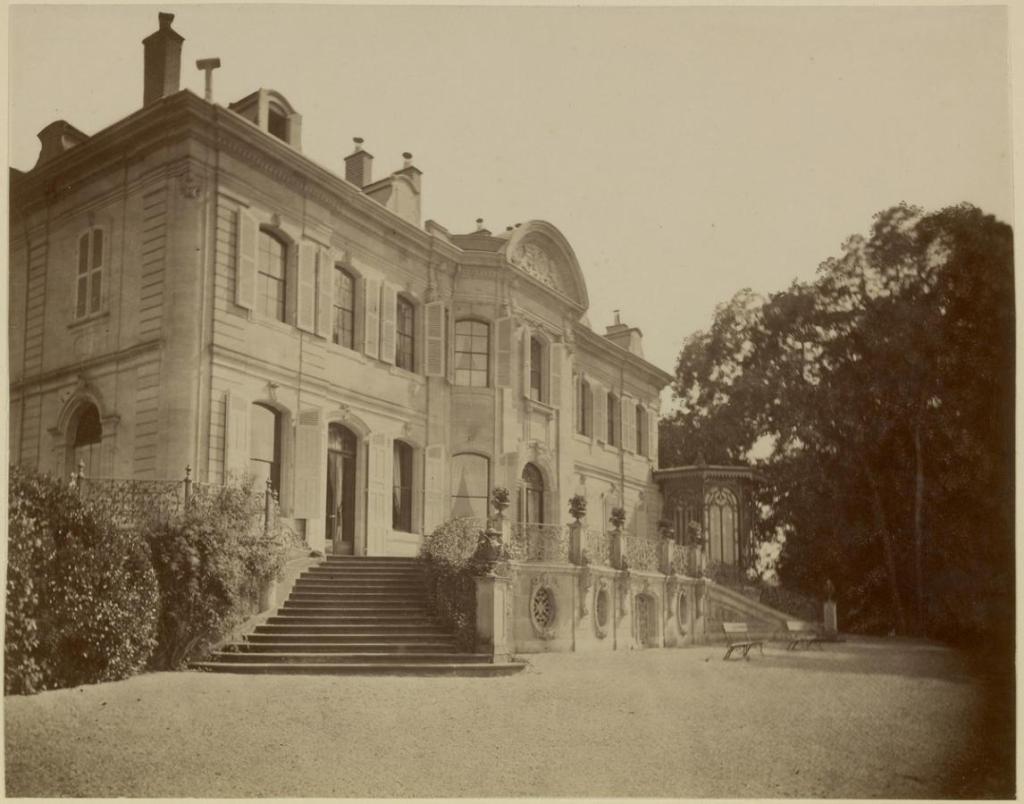
The park is now an English landscape garden, which characteristics are seen in the way, visitors can lose themselves along meandering paths or among trees. Approaching the park from the top of the hill, you get the optimal experience of the park. Entering from Rue the Frontenex, a straight and gentle sloping path leads down towards the lake, which is hidden behind the trees. Once you’re on the plateau, you experience a beautiful panorama of the shimmering shades of blue colour of the water. The elegant and imposing mansion, which is partly sheltered on the southern side with stately trees is on the plateau as well. Behind the trees you find the barn, stables shed and a double basin fountain which are part of the original layout of the estate. On the north side of the building we enjoy the elegant façade. The villa Grange is built between 1768 and 1773 order of the family Lullin. It was mainly used as a summer residence and to receive distinguished guest. The Lullins attributed to the architect Jean Louis Bovet. Who is known for one of the pearls of the Geneva architecture of the second half of the 18th century, the Chateau the Crans-pre-Celigny. Bovet was master builder from 1721 in Geneva and became architect around 1750. He died in 1766, the chateau Crans and the villa Grange were almost certainly completed by the Geneva architect Jean Jacques Vaucher (1734-1810). In 1800 Jean Lullin, at that time a banker and ruined by the revolution, sold the estate to the Francois Favre. Favre had made a fortune in Marseille through trade with India and wanted to settle in Geneva. Different generations of the Farve family added their own touch to the estate.
What does the building make so special?
We see a perfect symmetrical construction, a main building with two curved wings set at right angels. The façade as the interior shows us the architectural subtleties from the 18th century French architecture. We see an elegance and harmony in the details. A triangular pediment, bearing the Lullin monogram, greets visitors on the courtyard side, while the Favre-Cayla had theirs engraved on the lake façade in the early 19th century. Inside, arrangement of the doors an windows opening onto the hall are evidence of a highly practical approach and a desire to promote a sense of well-being. The dinning room is in the northwest part of the villa so that it stays cool, while several sitting rooms, offices and the library now share the ground floor. A separate staircase leads to the upper floor where different apartments comprising an antechambe, a wardrobe and a bedroom lead off from a very convenient central corridor.
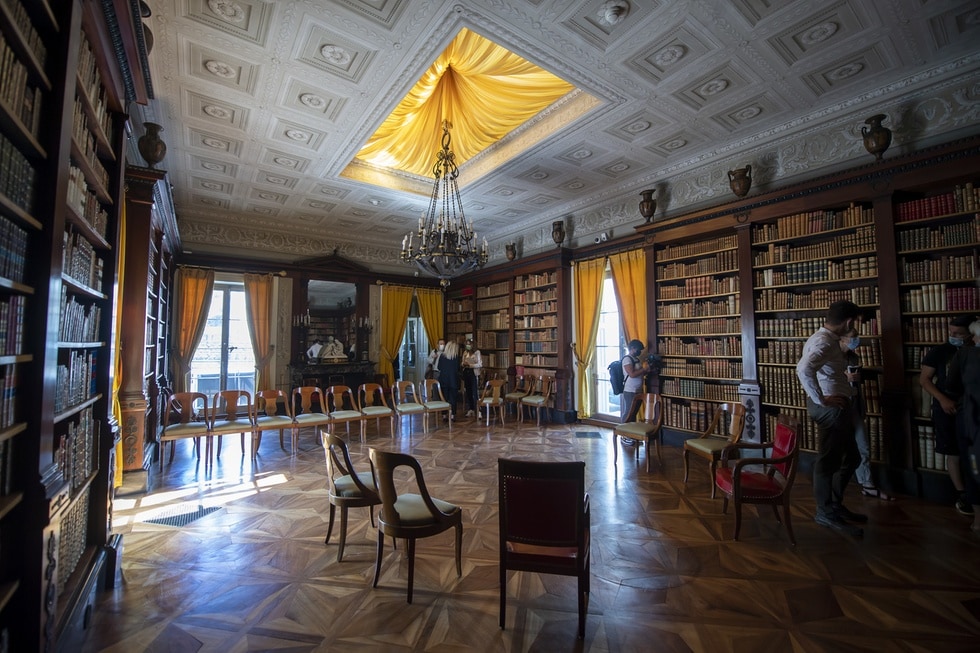
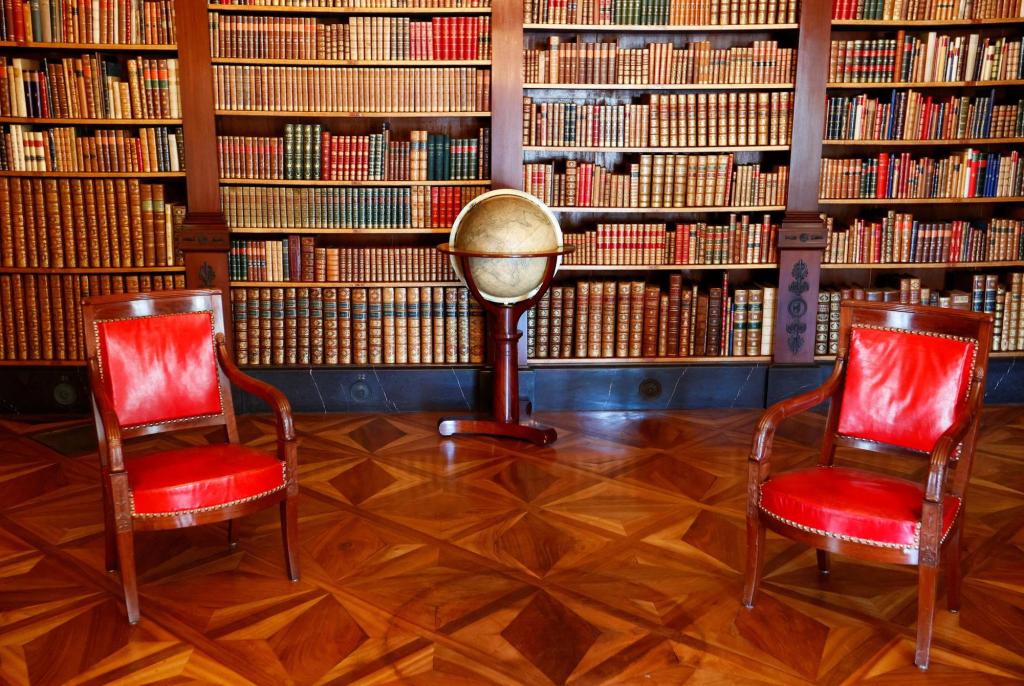
The interior decoration has evolved over time. Guillaume Favre, for example, refurbished the louis XVI main sitting room in to Empire style. He also redecorated the bedrooms on the upper floor. The interior is now mainly as it was when left to the city around the end of the first world war. The main achievement Guillaime Favre did was the library, its interior and the books. During the first half of the 19th century, he collected over 12,000 volumes kept in three adjacent rooms on the ground floor, two of which were transformed for this function, and a fine, large, rectangular purpose-built annexe with a flat roof on the right hand side of the villa. The addition of a pergola around it in 1854 was the work of his son Francois Edmond. Inside, the empire style bookcase reach almost the painted tromp-l’oeil ceiling. Antique vases, tables busts and sculptures decorate the space. Those fortunate enough to enter the holy of holies are struck by the beauty of the gilded leather spines of so many books. Yet it was not only for the aesthetic reasons that Guillaume Favre assembled this rich collection. He was one of the founders of the reading society and the History and Archaeology society. He was also board of Geneva library. His library was first and foremost a working tool. Half of the books were printed in the first half of 19 century. The oldest however, the incunabula, date back to the fifteenth century, prior to the invention of printing. Nowadays enlightened amateurs or researchers may ask to consult these works at the Geneva Library.
The Swiss media reports about the preparation of the estate, including the taken security measurements. The park is closed since last week, the security is on a high level in all of Geneva. Evelyne Chatelain, the estate manager has been busy with preparing the villa for the summit. She is used to welcoming VIPs. Indeed, this Villa La Grange is intended to welcome distinguished guests There have been several wishes from both of the delegations. In the dining room where the Swiss delegation is due to welcome its guests, the chandelier had to be raised. Indeed, one delegation believed that the initial height could spoil a point of view. Heritage protection measures for the works in the building have been taken, explains Nelly Cauliez, conservation commissioner for the City of Geneva. About sixty objects, mainly furniture and books, were taken out of Villa La Grange to be stored in a secure deposit. It is not only a question of preserving them but also of freeing up space. „Our patrimonial conditions have always prevailed over the requirements of delegations”, noted Ms. Cauliez. An air conditioning system could be installed in this listed building using the original ventilation grilles on the ground. The air conditioning is thus invisible and ensures a temperature between 18 and 19 degrees ideal for diplomatic exchanges and the conservation of works.
It seems to me that the park and the villa Grange are ready to host the summit. The history of the estate shows a lot of wise people have been here and knowledge of world topics is gathered in the library. The ideal place for a successful presidential summit, if you ask me. That makes me wonder if the two world leaders have any notion of it? Or are they just there to write their own history?
Sources:
Patrimoine de la ville de geneve.
Geneva library.
NZZ.
 I spy with my historical eye